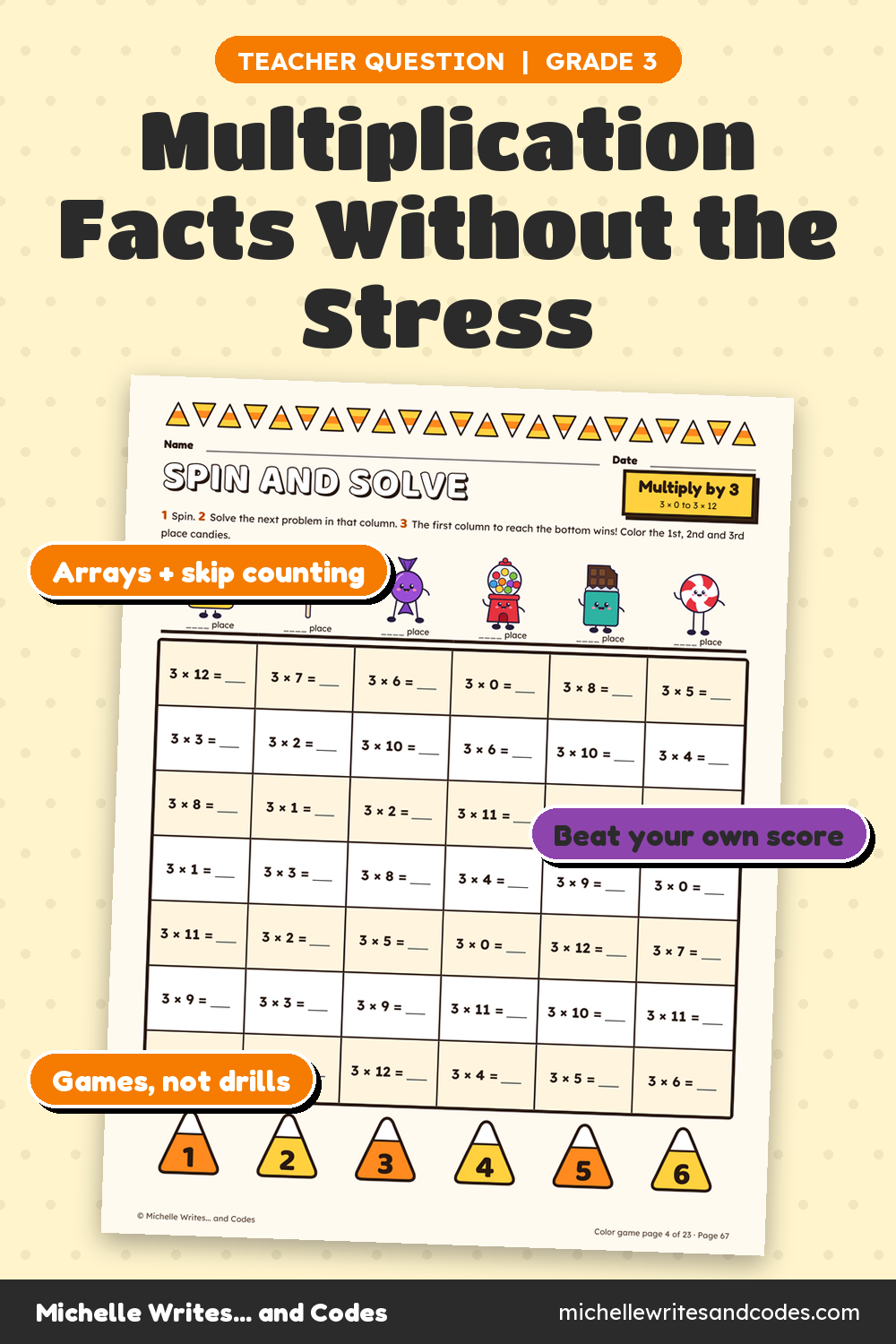
A third grade teacher recently asked a question I hear every fall: how do you help third graders learn their multiplication facts without turning math time into a stressful race against the clock? It is a great question, and the good news is that kids do not need panic to get fast. They need understanding first, then lots of friendly practice. Here is how I would approach it.
Start with skip counting and arrays
Before a child can recall 6 x 7 in a second, that fact has to mean something. Multiplication is equal groups, and the easiest way for eight-year-olds to see equal groups is with skip counting and arrays.
Have students skip count by 2s, 5s, and 10s out loud, then move to 3s and 4s. Then build arrays with counters, grid paper, or even a muffin tin. When a child builds 4 rows of 6 and sees it, they understand that 4 x 6 and 6 x 4 are the same array turned sideways. That one idea cuts the number of facts to memorize almost in half.
Teach strategy before speed
Speed is the last step, not the first. Before you ask for fast recall, give kids tools they can use to figure out a fact they do not know yet:
- Doubles: 2 x a number is just a double. Kids already know doubles from addition.
- Tens and fives: 10 x anything is easy, and 5 x is half of 10 x.
- Break it apart: if a child does not know 6 x 7, they can use 5 x 7 = 35 and add one more group of 7 to get 42.
- Nines pattern: the digits in the answer add up to 9, and the tens digit is one less than the number you multiplied by.
Use low-stakes timed checks where kids beat their own score
A short check can actually be motivating if the only person a child competes with is themselves.
Here is a format that works well. Give a one-minute check with a small set of facts, no more than you have already practiced. Students record their number correct, and next week they try to beat that number. No one calls out scores, no one posts a chart with names, and no grade goes in the gradebook. A student who goes from 8 to 11 has something to be proud of, whether the class average is 10 or 30.
Make partner practice a routine
Partner work lowers the pressure because a classmate is a friendlier audience than a stopwatch. Two easy routines:
- Quiz and coach: one partner holds a card and asks, the other answers. If they miss, the coach shows a strategy instead of just saying the answer, and then they swap.
- Cover and say: one partner covers part of a fact family with a finger, and the other says the missing number.
Five focused minutes a day with a partner beats a long drill session once a week. Rotate partners so kids hear different ways of thinking.
Play multiplication fact games in your centers
Games give kids dozens of repetitions without it feeling like practice. For multiplication fact games in 3rd grade centers, I look for three things: low prep, easy to differentiate, and a built-in way to check answers.
Our Spin and Solve games are built exactly that way. Each student spins, solves the next problem in that column, and races friends to the bottom of the page. Because every page focuses on one factor, such as multiply by 3 or multiply by 6, you can hand each child the page that matches where they are. The whole class plays at once, so you are not stuck running a game for one small group while everyone else waits. These are printable multiplication games with no prep beyond running copies, and each comes with an answer key.
Since this is the season for it, here are the multiplication versions by holiday:
- Halloween Candy Spin and Solve: Multiplication works well for a Halloween multiplication game in 3rd grade, with candy characters for kids to race.
- Fall Spin and Solve: Multiplication is a good fit for the weeks around Halloween and right on through November.
- Thanksgiving Spin and Solve: Multiplication gives you a turkey-themed race for the week before break, and it pairs well with the multiplication and division word problems you are probably already doing around Thanksgiving.
If you want every operation for your whole grade level, the 4-pack bundles include addition, subtraction, multiplication, and division: Halloween, Fall, and Thanksgiving.
Sale note: use code FALL20 at checkout for 20% off through Saturday, October 24, 2026.
Track growth with a simple bar graph
Here is the piece that turns practice into motivation. Give each student a small bar graph, one bar per week, showing their number correct on the one-minute check. Students color in their own bar, and the graph belongs to them to keep in a math folder.
Kids love watching their bars climb, and it gives you a real math connection too, because they are reading and making a bar graph with their own data. When a bar dips, that is a conversation, not a failure. Maybe they were absent, maybe the facts got harder, and maybe it is time for a new strategy. A growth graph also gives you something concrete to show families at conference time, without a single ranking.
A simple weekly plan
If you want something you can start Monday, try this:
- Monday: teach or review one strategy with arrays or skip counting.
- Tuesday and Wednesday: partner practice for five minutes plus a center game.
- Thursday: another game day, with students choosing the factor page that fits them.
- Friday: a one-minute self-check, then add a bar to the graph.
Keep the set of facts small each week, and add new ones slowly. Kids who feel successful keep trying, and kids who keep trying get faster.


